



The History Of Skirting Boards | Origins & Modern Designs
Posted by Lee Watkinson | Aleesha Gohil on 24th Apr 2026
Almost every British house has skirting boards. It's a detail you hardly notice as they're always there. But the plain painted board at the base of every room is the last surviving part of a much more elaborate classical interior finish that once covered the whole wall.
Quick answer
- The word "skirting" is first recorded in English in 1687, and "skirting board" before 1756.
- Before the late seventeenth century, most interiors did not have a separate skirting board. The wall-to-floor junction was handled by full-height timber panelling.
- Skirting boards emerged as a distinct trim as plastered walls replaced panelling, from the late seventeenth century onwards.
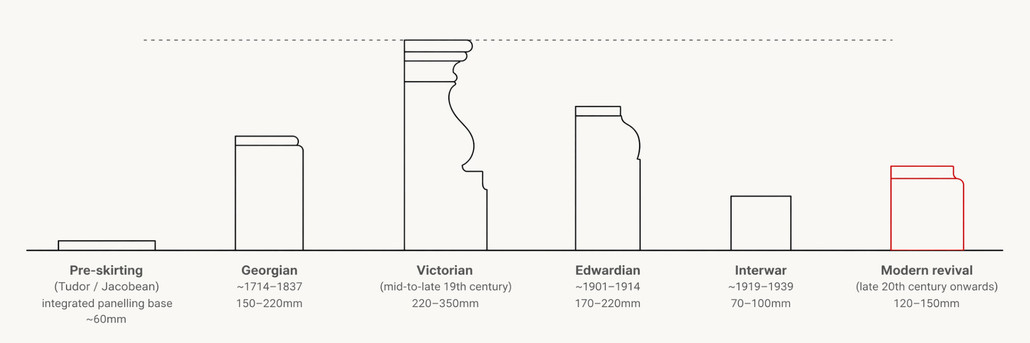
- Victorian skirting boards were the tallest. Interwar building made them shorter. MDF made period heights affordable again from the late twentieth century.
What came before skirting boards
Interior walls in Tudor and Jacobean houses were rarely finished with a separate skirting board. Where wealth allowed, the wall itself was the joinery. Oak wainscot panels ran from floor to ceiling in a single timber system, and the lowest horizontal member of that panelling sat directly against the floorboards.
In simpler cottages with damp flagstone or earth floors, a decorative timber board would have rotted, and was rarely used. For most of British history, the painted skirting board was a feature of a particular kind of interior rather than a universal one.

National Trust records for the panelling at Gilling Castle describe its lowest band as a "skirting frieze". The phrase is useful because it bridges two eras in two words: a piece of integrated panelling described with the newer word, at the moment when function and language were just beginning to separate.
How skirting boards appeared
The change came with the plastered wall. Through the later seventeenth and early eighteenth centuries, lime plaster replaced full-height wainscot as the standard finish. The bottom of the wall still needed protecting from mops, kicks, and furniture, and the skirting board in its modern form emerged in that gap. The OED first records "skirting" as an architectural term in 1687 and "skirting board" before 1756.
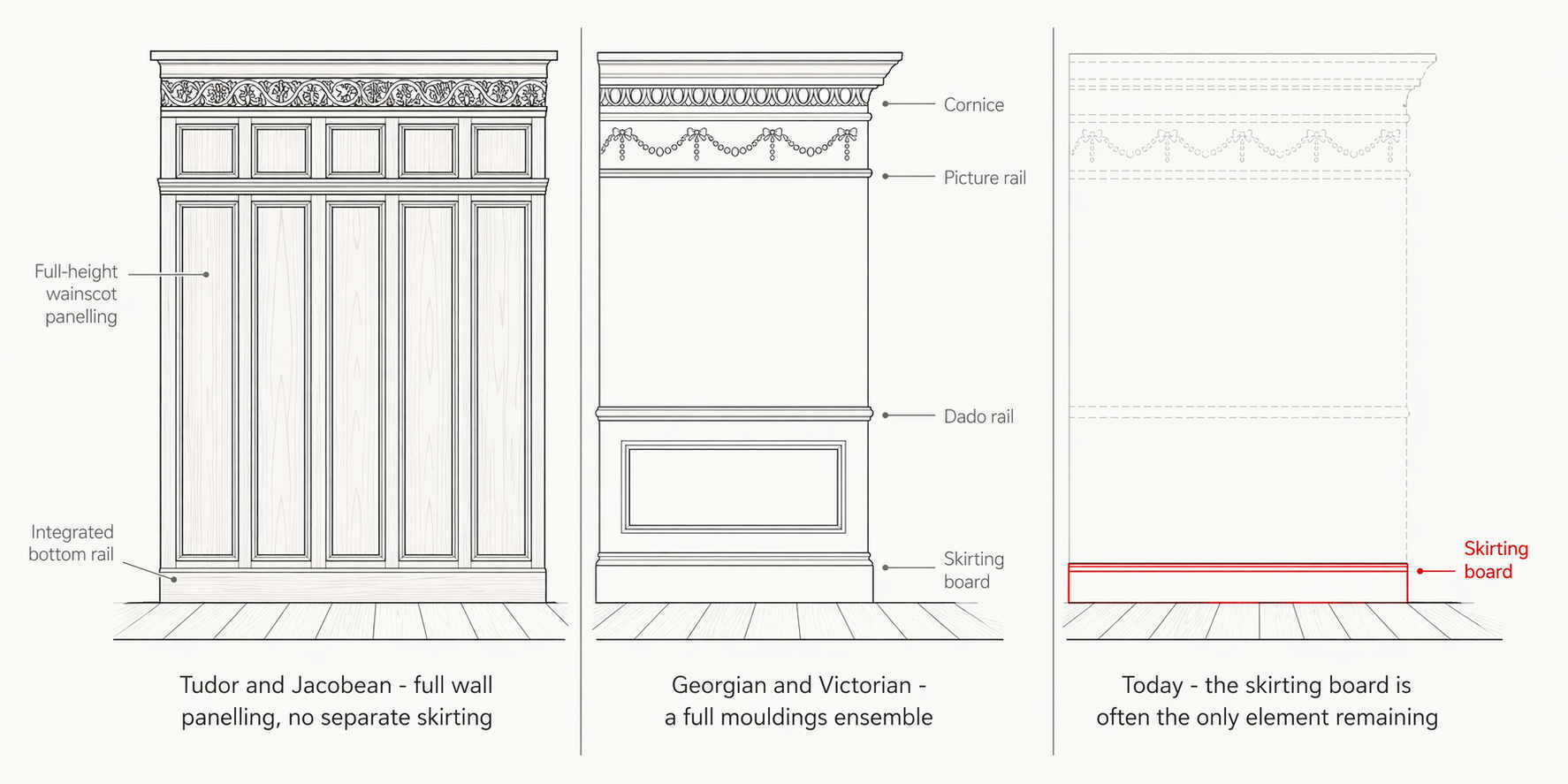
By the middle of the eighteenth century, Georgian pattern books were spreading a standard classical vocabulary of interior mouldings to carpenters across the country. Batty Langley's The Builder's Jewel (1741), Isaac Ware's A Complete Body of Architecture (1756), and Peter Nicholson's Carpenter's New Guide (1792) gave the trades a shared grammar of bases, plinths, cornices, and architraves. Late-Georgian drawings in the Sir John Soane's Museum collection list the elements being designed together as a set: "cornices, friezes, skirting, and door and window architraves in different rooms".
A room as a classical column
The system Georgian architects used to organise a wall was borrowed from classical architecture: a wall read as a column laid out vertically. The skirting is the column's base. A dado panel and dado rail take the place of the pedestal. The flat wall above is the shaft. The frieze band is the entablature frieze. The cornice is the entablature cornice.
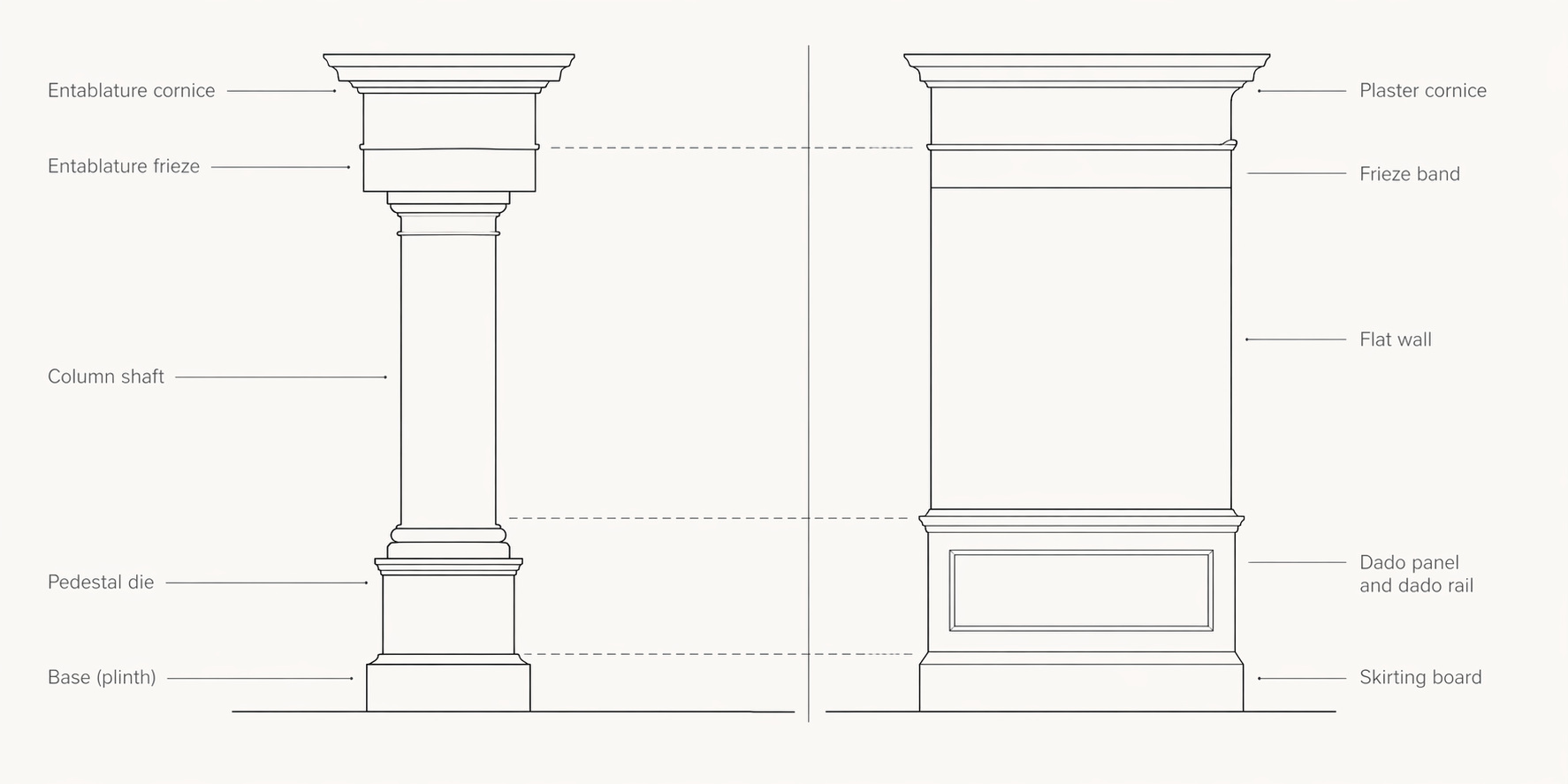
The Georgian Group describes this arrangement as the underlying logic behind the mouldings found in period interiors. It is not a strict rule, and it was not always followed precisely, but it explains why the elements look like a set even in very different rooms. The rest of the story becomes easier to follow once you see it: Victorian decoration is an elaboration of this grammar, Edwardian restraint is a calming of it, interwar austerity starts to lose it, modernism rejects it, and MDF has made it possible to speak it again cheaply in period renovations.
Why they are called skirting boards
"Skirting" comes from the sense of a border or edge, the same root as the garment. Applied to architecture, it described a band of finishing material along the base of a wall. The older word "wainscot" came into English around 1352 from Middle Low German wagenschot, originally meaning "wagon wood", a grade of imported oak.
First recorded use in English
-
1352
wainscot
-
1563
architrave, cornice
-
1664
dado
-
1687
skirting
-
1703
coving
-
pre-1756
skirting board
-
1854
baseboard (US, modern sense)
-
1887
picture rail
Dates per the Oxford English Dictionary, with Etymonline for the modern trim sense of "baseboard".
North American English settled on "baseboard" rather than "skirting board", and architrave is the British term for what American carpenters call door or window casing. The picture rail is a surprisingly late addition to the vocabulary. It appears only in 1887, firmly at the end of the Victorian period, which is why it belongs almost as much to Edwardian interiors as to Victorian ones.
Mouldings at a glance
A shorthand reference to the main eras. Heights are approximate ranges drawn from surviving building stock and heritage-body guidance rather than prescribed standards.
| Era | Dates | Typical height | Profile character | Material |
|---|---|---|---|---|
| Tudor / Jacobean | to c. 1660 | No separate board | Integrated into panelling | Oak wainscot |
| Georgian | 1714-1837 | 150-220mm | Classical, proportioned | Pine, occasionally oak |
| Victorian | 1837-1901 | 220mm and upwards | Stacked, articulated | Imported softwood, painted |
| Edwardian | 1901-1914 | 170-220mm | Single curve, cleaner | Softwood, painted |
| Interwar | 1919-1939 | 70-100mm | Plain, chamfer or pencil round | Cheap softwood |
| Post-war | 1945-c.1980 | 70-100mm or shadow gap | Minimal or absent | Softwood or none |
| Modern revival | c.1990s onwards | 120mm to period heights | Reproductions of period profiles | MDF, often moisture-resistant |
Why Victorian skirting were so tall

Several things happened at once. Gas lighting was common in middle- and upper-class houses, and ceilings in primary rooms were often tall to help disperse its heat and fumes. Taller ceilings drew the proportions of the wall upwards, and the skirting went with them.
Plaster walls were more fragile than panelled walls had been, so a deeper timber buffer made practical sense in houses cleaned daily with mops and furnished with heavy caster-wheeled pieces. Steam-powered rotary milling, newly available in the second half of the nineteenth century, made deep profiles affordable.
In primary reception rooms, skirtings often reached 220mm and beyond, sometimes approaching 300mm.
"There are considerations of dignity essential to the plan of a gentleman's house... a refinement of elegance."
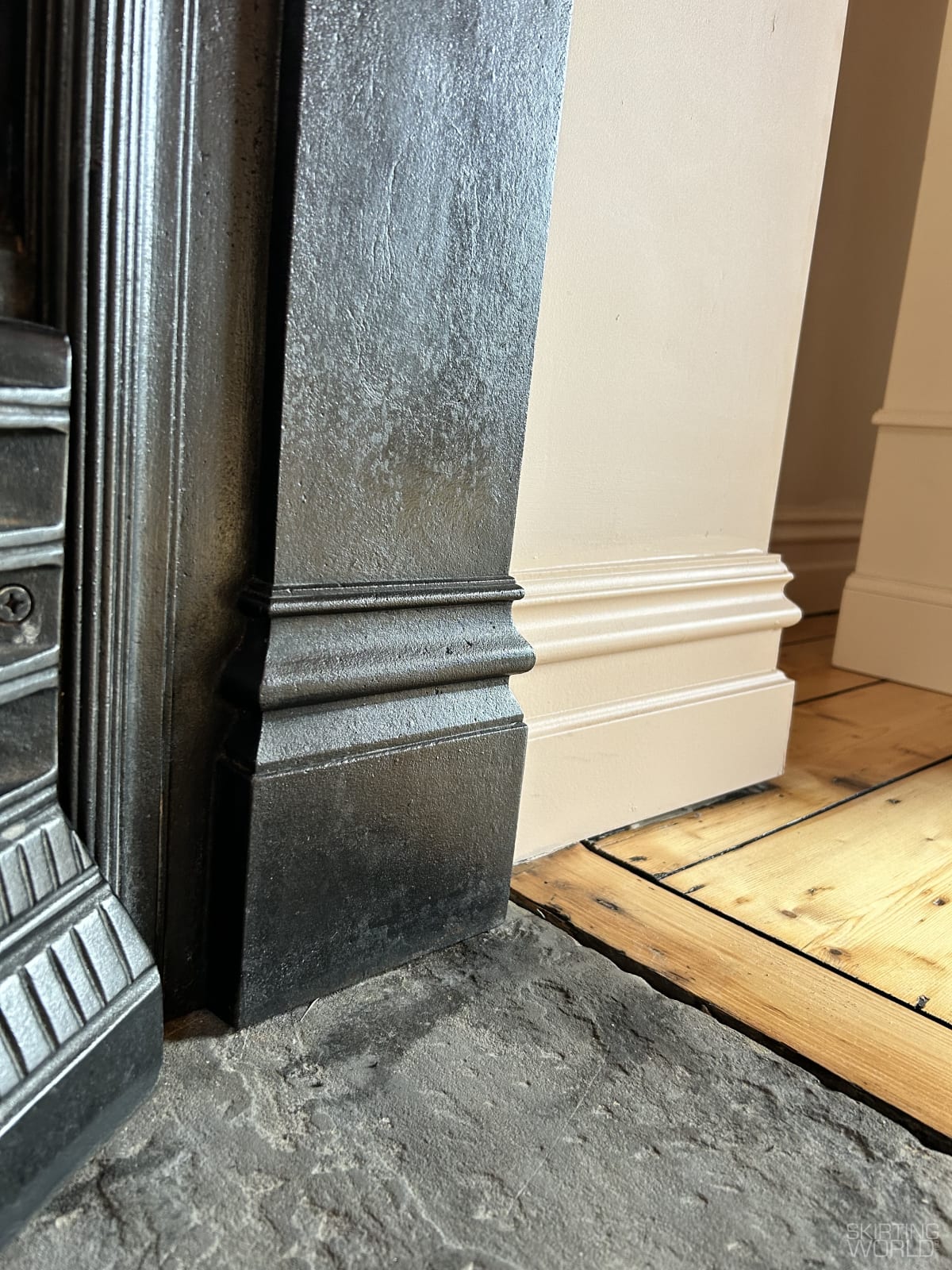
Victorian writers spoke of architecture in these qualitative terms rather than giving numeric rules for skirting heights. The V&A's material on nineteenth-century interiors describes the Victorian wall as typically divided into three horizontal bands, a dado beneath, a filling above it, and a frieze below the cornice. A tall skirting board made sense as the foundation course of that layered wall. Our guide to skirting board heights covers how these period proportions translate to modern ceiling heights.
Edwardian Skirting Boards
The Edwardian period covers a shorter run than most people realise: roughly 1901 to 1914. A reaction had set in against the density of high-Victorian decoration. Arts and Crafts architects favoured lighter rooms, honest materials, and simpler profiles. Mouldings did not disappear. They were pared back.
Skirting boards remained substantial, often in the 170 to 220mm range, but the profiles tended to be single curves rather than stacked combinations. A plain torus or light ogee did more work than the layered Victorian mouldings. Ceilings began to ease down as electricity replaced gas, and the wall needed less vertical emphasis at its base. The period is best understood as an unwinding of Victorian complexity rather than a rupture from it.
Skirting boards getting smaller after 1919
The First World War and its aftermath weakened the link between skirting boards and the classical tradition they had grown out of. The 1919 Housing, Town Planning, &c. Act, usually called the Addison Act, launched the first large state-funded housing programme in Britain. Over the following two decades, many homes were built to tighter budgets and with a more standardised approach to internal joinery than before.
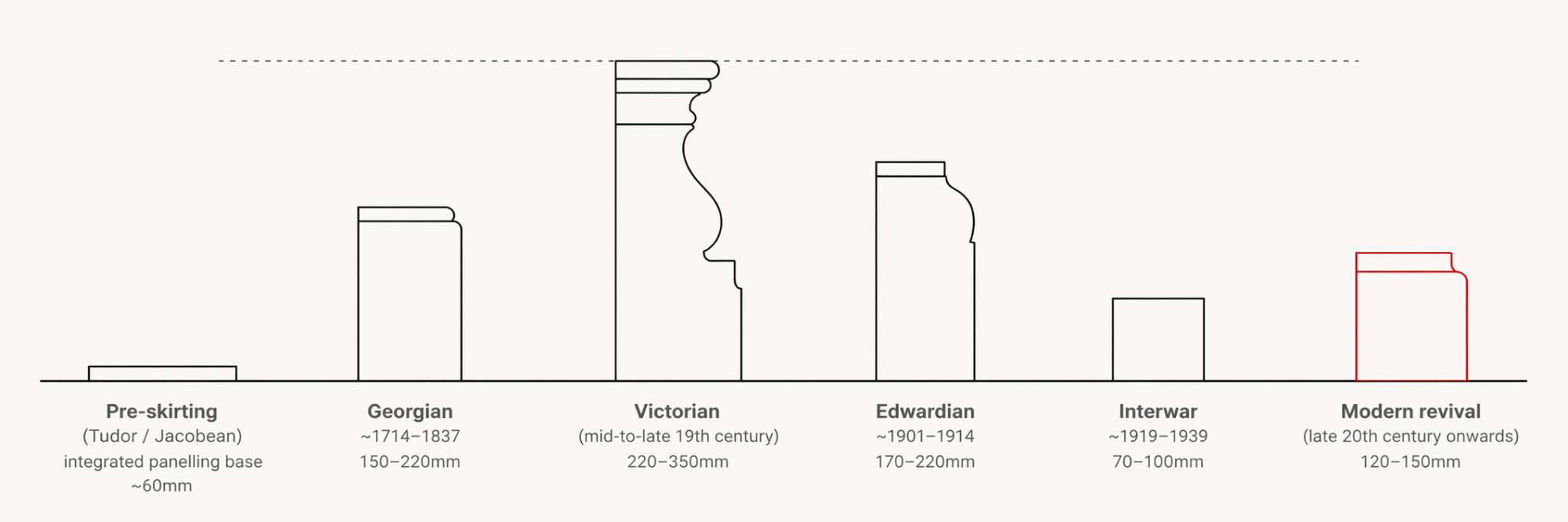
Skirting in speculative suburban and council housing dropped from the Victorian and Edwardian range to something closer to 70 to 100mm. Profiles simplified in parallel. A plain pencil round or shallow chamfer replaced the stacked mouldings of a generation earlier. Dado rails and picture rails were quietly dropped from the standard repertoire of volume housebuilding. The interiors of the 1920s and 1930s still had skirting boards because the wall-to-floor junction still had to be finished, but the wider classical ensemble was no longer being built.
Modernist Skirting Boards
The post-war period continued the direction the interwar years had started, on a different philosophical footing. Modernist architects rejected applied ornament on principle. The skirting board was a leftover from an older way of thinking about rooms. Where it was kept, it was reduced to a thin functional strip; in more carefully detailed interiors it was replaced by a shadow gap, a recessed joint between wall and floor that does the same structural job without being seen.
Today, Historic England's retrofit guidance treats tall skirtings, dado rails, picture rails, and plaster cornices as historic fabric likely to be disturbed by insulation work. That language alone tells you what happened. By the late twentieth century, the full mouldings ensemble had become a survival from older housing stock rather than a default feature of anything new.
How MDF brought tall skirting boards back
The revival of period heights in ordinary British homes is mostly a story about material. Medium-density fibreboard was first produced commercially in the United States in 1966, and a European production line followed in 1973. The United Kingdom's first MDF mill opened at Cowie in Scotland in 1979, and Medite's plant at Clonmel, Ireland opened in 1983. By the late 1990s, moisture-resistant MDF was an established option for painted interior joinery in the UK and Ireland.
What MDF offered the mouldings trade was consistency. It has no grain direction and no knots, which means it can be machined into deep historical profiles without splintering, and it takes paint with a uniformity that softwoods struggle to match. Those qualities matter more for tall skirtings than for short ones.

A 70mm softwood skirting in an interwar semi is a forgiving piece of carpentry. A 250mm painted Victorian profile in a renovated terrace is not. MDF made it possible to reproduce the deeper profiles of the Georgian and Victorian periods accurately, in stable long lengths, at a price that put them back within reach of ordinary renovation projects.


Today's skirting boards include moulded recreations of most of the period profiles the trade had lost by the 1950s, made from a material that only arrived in the UK a generation earlier.

Interior Design Specialist
"As a designer, I find the history of skirting boards really interesting because they've always balanced practicality with aesthetics. Originally, they were introduced to protect walls from wear, hide uneven plaster finishes, and reduce draughts in older buildings, but over time they became much more decorative, particularly in Georgian and Victorian interiors, where taller, more detailed profiles were used to reflect the proportions and status of a space. What I find valuable about understanding that evolution is how directly it informs design decisions today. During one of my university projects, I worked on a concept inspired by period interiors, and I remember how much difference the skirting profile made to the overall feel of the room. Once I introduced a taller, more detailed skirting board, the space immediately felt more grounded and authentic to the style I was aiming for. That experience really highlighted how these historical details still shape how we perceive proportion and character in a space. I think bringing that perspective into the content helps bridge the gap between history and practical application, making it easier for customers to understand not just where skirting boards come from, but how to use them more intentionally in their own homes."
How skirting boards were attached before power tools
Skirting in solid-brick Georgian and Victorian houses had to solve a problem that is easy to forget. A nail driven straight into mortar or brick will not hold reliably. The carpenters of the period worked around this with a simple, invisible system.
Drive wooden plugs into the mortar joints
The carpenter chopped out sections of vertical mortar joint between bricks and hammered wedge-shaped softwood plugs into the gaps. Once driven, the plugs held firmly in the lime mortar.
Nail a timber "ground" to the plugs
A rough softwood batten called a ground ran horizontally along the base of the wall, nailed into the concealed plugs. Its top edge was often bevelled, both as a key for the plaster and as a visible guide for the plasterer.
Float the plaster flush with the ground
The plasterer applied lime plaster to the brickwork above, working it out until the finished plaster face sat level with the outer face of the ground.
Nail the skirting into the ground
Once the plaster was dry, the carpenter returned and nailed the skirting board through its face into the concealed ground behind it. If you have ever lifted a Victorian skirting and found a long rough batten running along the base of the plaster, what you are looking at is a ground, still doing its job.
Common questions
When were skirting boards first used in British houses?
In something close to their modern form, they appeared in British houses during the later seventeenth and early eighteenth centuries, as plastered walls replaced full-height timber panelling. The word "skirting" is first recorded in English in 1687, and "skirting board" before 1756. Earlier interiors had a timber lower band, but it was usually the base of a panelled wall rather than an applied decorative trim.
Why do Victorian houses have tall skirting boards?
Several factors acted together. Gas lighting encouraged taller ceilings, which pushed the proportions of the whole wall upwards. Plaster walls needed more protection from daily cleaning and heavy furniture, and steam-powered milling made deep profiles affordable for the first time. Victorian writers like Robert Kerr spoke of "dignity" and "refinement" rather than specific heights, but the practical result was skirtings that often reached 220 to 300mm in primary rooms.
Did old cottages have skirting boards?
Many did not, in the modern sense. Tudor and Jacobean interiors commonly handled the wall-to-floor junction through full-height wainscot or panelling, where the lowest horizontal member was integrated into the joinery rather than applied as a separate board. Simpler vernacular cottages with damp flagstone or earth floors usually had no skirting at all, because a timber board in those conditions would not last. The separate painted skirting board became common in larger, more formal houses from the Georgian period onwards.
Why is it called a skirting board?
The name comes from the idea of a border or edge running along the perimeter of something, the same root as the garment. Applied to architecture, it described a band of finishing material along the base of a wall. The earliest architectural use of "skirting" in English is recorded in 1687, and the compound "skirting board" appears by the 1750s.
What do Americans call a skirting board?
Americans call it a baseboard. The word itself is older, going back to 1598, but its modern sense of a finishing band around the base of an interior wall is dated to 1854. British and Commonwealth English stayed with "skirting board". The two names refer to the same architectural element.
Why did skirting boards get shorter after the 1920s?
The 1919 Housing Act launched a large state-funded housebuilding programme, and the interior joinery of mass suburban and council housing was standardised to keep costs down. Skirting heights dropped from the 220 to 300mm range typical of Victorian rooms to around 70 to 100mm, and profiles simplified. Post-war modernism continued the direction on aesthetic grounds. Taller period-style skirtings have become common again only since the widespread adoption of MDF in the late twentieth century.